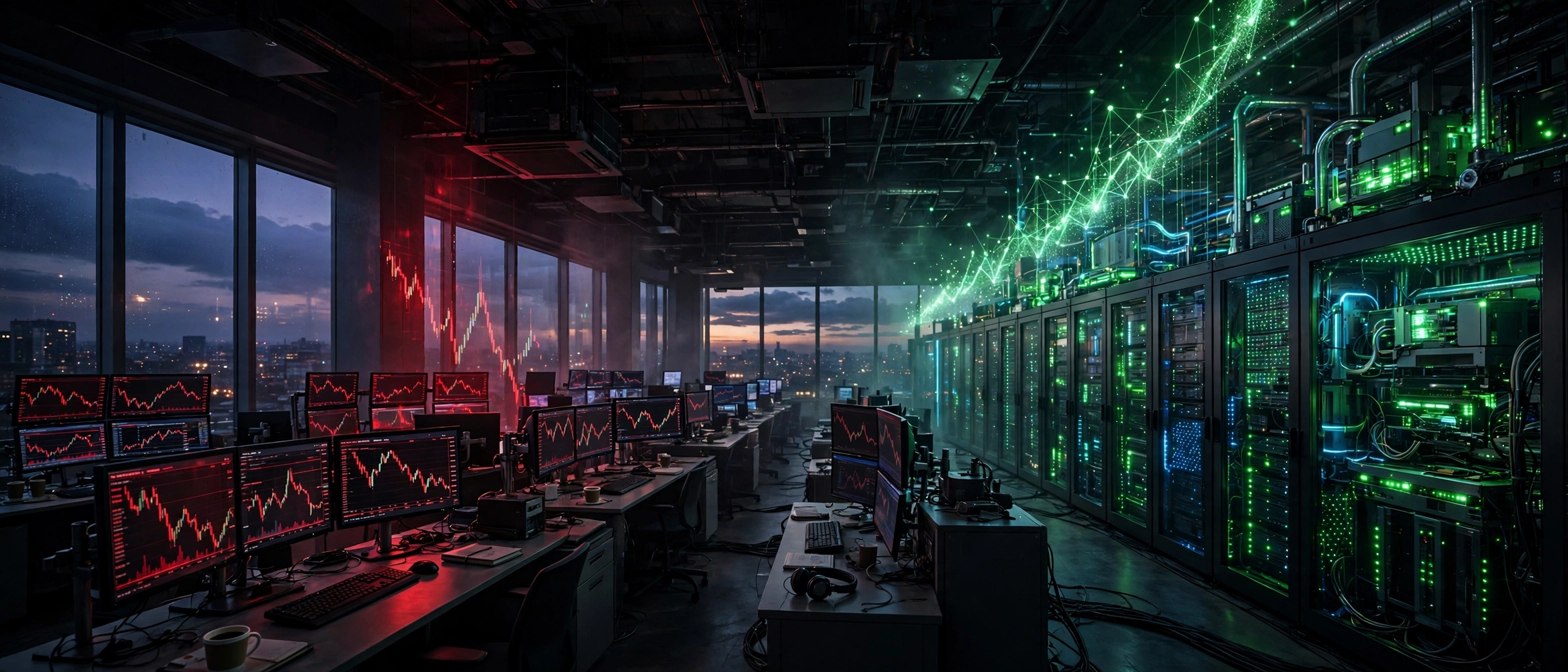
After years of cheering every AI dollar, the market spent October asking who pays, who bears the debt, and when the cash comes back.
October ended with a blunt question hanging over the technology industry. After years in which investors cheered every dollar poured into artificial intelligence, did October mark the moment they started asking for proof? The numbers from the month suggest it did. Big Tech spent more than ever, returned less cash than ever, and the market answered with its worst month in more than a year. The buildout is not over — if anything, the spending forecasts got bigger — but October changed the terms of the debate.
The October Scoreboard
October ended with a thud. The Nasdaq Composite had its biggest single-day decline since June on Friday, and the Nasdaq 100 fell 3.5 percent that day, putting it on the brink of a correction, a drop of 10 percent from its recent high. Zoom out, and the month looks even rougher. More than $2 trillion in market value is set to be wiped from the Nasdaq 100 in October alone. The index fell more than 5.8 percent in the month, and the Nasdaq Composite is now down 7.8 percent from its closing high, after its worst month since March 2025.
What Changed: A Pattern, Not One Bad Report
What changed was not one bad earnings report. It was a pattern. Microsoft, Meta, Amazon, and Alphabet all saw their shares fall 1 to 2 percent on Friday, after much bigger declines earlier in the week. Alphabet suffered its biggest one-day percentage drop on record on Thursday, after disappointing results in search advertising and a sharp acceleration in cash burn. Here is a striking detail from Capital Economics, reported by Reuters: those four companies have been responsible for more than a third of all the capital spending by the current members of the S&P 500 over the past twelve months, and their share seems likely to rise further. Investors are struggling with that prospect, especially as borrowing costs rise.
The Spending Forecasts Only Got Bigger
Morgan Stanley now forecasts that capital spending on AI infrastructure overall will pass $1 trillion next year. JPMorgan expects global AI capital spending to reach $5.5 trillion by 2030, with $900 billion spent in 2026 alone. So the question is not whether the spending continues. It is whether the returns arrive fast enough to pay for it. That tension — enormous ambition funded at enormous scale — runs through every other story this week.
Big Tech’s Cash Squeeze: Record Cash In, Record-Low Cash Returned
The biggest American technology companies generated record amounts of cash in the first nine months of 2026, yet they returned the smallest share of it to shareholders in at least fifteen years, because surging AI spending squeezed share buybacks. Microsoft, Alphabet, Amazon, Meta, and Oracle returned 9.3 percent of the cash their businesses generated as dividends and buybacks in the first three quarters of the year, down from 27.4 percent a year earlier, according to a Reuters analysis of market data and company financial reports. Operating cash flow actually rose 29 percent from a year earlier, to a record $542.9 billion. But capital spending, driven by the AI boom, doubled to $556.9 billion, exceeding the cash the five firms generated for the first time in data going back to 2011. That left them with a combined free cash flow deficit of $14 billion, against a surplus of $143.5 billion a year earlier. Buybacks took the hardest hit, falling 83 percent to $13.6 billion, from $81.8 billion a year earlier.
Why Fewer Buybacks Matter
Alphabet and Meta have not repurchased a single share in 2026, after buying back $66.5 billion in the first nine months of last year. Amazon pays no dividend and has not bought back shares since 2022. This matters because buybacks have long supported technology share prices. With fewer buybacks, investors depend more heavily on AI investments delivering enough profit growth to justify the valuations. In other words, the safety net is thinner at exactly the moment the spending is larger.
The Leverage Behind the Buildout: Nvidia, Nscale, and Anthropic
A new financing story shows just how creative — and how leveraged — the funding behind this buildout has become. Nvidia is in talks to offer billions of dollars in credit guarantees to support debt funding for a data center earmarked for Anthropic, according to The Information, as reported by Reuters. The credit support would help fund power infrastructure and construction of Nscale’s AI data center in West Virginia, which Anthropic plans to use. Nvidia is an investor in Nscale, the Britain-based cloud provider, and the deal has not been signed, with terms still able to change. This follows a deal in August in which Anthropic, the maker of Claude, agreed to spend $45 billion to rent computing power from Nscale’s West Virginia campus. Nscale is also in talks to sell about 460 megawatts of AI computing power to Anthropic in another deal that could also be worth about $45 billion. Why does a credit guarantee matter? Because it sits at the heart of the worry we started with. Companies like CoreWeave and Firmus, both backed by Nvidia, have been hit by concerns about debt financing behind the AI buildout. A guarantee from Nvidia could make lenders more comfortable, but it also ties Nvidia’s fortunes even more closely to the companies building and renting these data centers.
Across the Pacific: Kling’s Near-$3 Billion Raise
The AI video race is getting very expensive, too. Tencent-backed Kuaishou Technology said on Friday that its unit Beijing Kling has completed a fundraising round of about 19.8 billion yuan, or about $2.98 billion. Kuaishou, the short-video platform operator, will hold two-thirds of the equity and 52.45 percent of the voting rights in the Kling AI maker, through its Lucky Labs holding vehicle. The fundraise comes after a $2.8 billion raise in July, which drew investors like Alibaba and Tencent, when Kling was valued at $15 billion before the new investment. Kling competes with AI video generation models from OpenAI, Google, and TikTok owner ByteDance, and Bloomberg News reported earlier this month that Kling is planning for an initial public offering next year. So this is a company raising at enormous scale, keeping control in Kuaishou’s hands, and aiming at a public listing while the video race is still wide open.
Character.AI: A Court-Approved Sale Over States’ Objections
In a very different kind of AI story, a United States bankruptcy judge on Friday allowed chatbot platform Character.AI to move ahead with a sale of its assets, overruling objections from state attorneys general who argued that the proposed auction unfairly favors Disney. Character.AI filed for bankruptcy on October 12, with Disney agreeing to set an initial bid of $20 million for a non-exclusive license to Character.AI’s chatbot technology. Disney does not plan to buy the chatbot platform or user data, including chat history. The company blamed lawsuits, regulatory probes, high costs for AI talent and computing power, and an unprofitable business model. Without further investor backing, it was losing $8 million to $9 million a month, as employee and computing costs far outweighed revenue from advertising and user fees. The attorneys general for 41 states objected, arguing that Disney had stacked the deck by hiring most of Character.AI’s employees, including its former chief executive, before bankruptcy. Disney hired 66 of the company’s 86 employees, and expects to pay them $180 million over the next three years. Character.AI expects to return to court on November 30 to seek approval of asset sales.
Quick Hits and What to Watch in November
Friday’s losers tell their own story:
- Chipmaker Intel and social media firm Reddit each fell 29 percent on Friday
- Sandisk, a chipmaker that has benefited greatly from the AI spending boom, dropped 13 percent
- Apple is set to report next week, and AI bellwether Nvidia is due in mid-November
Monday rings in a brand-new trading month, after a bruising October. If Apple and Nvidia can show returns catching up with spending, the mood could turn quickly. If they cannot, the October reckoning may just be the opening chapter. October did not kill the AI buildout. But investors are no longer just asking how fast companies can build. They are asking who pays, who bears the debt, and when the cash comes back.
Sources
- Nasdaq October wipeout as AI spending fears deepen: Reuters
- Big Tech returns smallest share of cash to shareholders in 15 years: Reuters
- Nvidia in talks to give credit support for Nscale’s Anthropic data center deal: Reuters
- Kuaishou’s Kling AI completes near $3 billion funding round: Reuters
- Character.AI moves ahead with asset sale over states’ objections: Reuters
- October ends with a thud for Intel, Reddit and AI stalwarts: Reuters
- Apple and Nvidia earnings ahead as next test of AI spending story: Reuters
Adapted from the October 31, 2026 episode of Daily Tech and AI.
Daily Tech and AI is AI-voiced and produced by Angelo Ruiz.
Leave a Reply